
Arrest Warrants in Ontonagon County
An arrest warrant is a charging document with teeth. Someone, a peace officer, a prosecutor, or even a private complainant, brings a complaint describing an offense, and the court then weighs whether probable cause exists. That finding can rest on the complaint alone, on an affidavit, on sworn testimony, or on some mix of the three. Michigan leans the other way first. A summons is the preferred route in most cases, and a warrant comes out only when the complaint alleges an assaultive or domestic-violence offense, when the person seems unlikely to appear, when public safety is at risk, or when the prosecutor asks. In Ontonagon County, the charging decision sits close to home and moves fast, so a warrant can follow quickly once a complaint is filed here.
Ontonagon County Complaint to Warrant Path
Four steps, no shortcuts. Someone files a complaint naming an offense. A judge or magistrate reviews the facts for probable cause. The court then issues either a summons or an arrest warrant, and the order goes to law enforcement for service or entry into the pickup system. Ontonagon County cases run the same path as the rest of Michigan. A warrantless arrest can also lead to a warrant, since the law lets a complaint and a reasonable-cause finding follow the arrest, and the case then proceeds on the same track. The court record controls throughout, so ask which document exists and who signed it.
What an Ontonagon County Arrest Warrant Contains
The governing rule is short, and so is the warrant. Michigan Court Rule 6.102 tells the court to identify the accused, describe the offense, command an authorized arresting person to bring the accused before the court, and subscribe the order. That is the whole document an Ontonagon County warrant carries.
| Warrant Number | Assigned by the court or agency. No local public format is published. |
|---|---|
| Named Subject | The accused's name, or an identifying description when the name is unknown. |
| Charge / Offense | The offense from the complaint, plus a felony or misdemeanor classification on the file. |
| Issuing Judge / Court | The judicial officer who signed, and the court where the person must appear. |
| Bond or Release Term | Any bail provision on the warrant, or release decided later at arraignment. |
| Date Issued | The issue date, which also starts the one-year clock for a voluntary appearance. |
A complaint does not prove a warrant was served. In Ontonagon County, the document authorizes an arrest and nothing more.
Ontonagon County District Court Before Circuit
Serious criminal cases in Ontonagon County run through two courts in order. The 98-2 District Court handles the early stage, including the probable-cause review that produces most local arrest warrants, and the 32nd Circuit Court takes any case that is bound over, with the county clerk keeping the file from that point. The handoff matters when a status seems to shift on its own. A warrant issued in the district court can still be enforced after the case moves up, and recall then sits with the circuit court. Call the district court first. If a felony matter stays unclear, also call the circuit contact at 906-884-4255. The prosecutor's office page shows the charging side of that same docket.
The prosecutor charges, the judge rules on probable cause, and the sheriff serves the order. Keep those Ontonagon County roles straight and you know who can actually answer your question.
How Ontonagon County Arrest Warrants Are Served
The Ontonagon County Sheriff Department is the primary local agency for service, working from 620 Conglomerate. Michigan State Police troopers, village officers acting under the sheriff-service arrangement, and other authorized peace officers can also act on a valid warrant. Where does service happen? At a residence, during a traffic stop, at a workplace, or when someone walks into a government building on unrelated business. After an arrest, Michigan Court Rule 6.104 requires the person to go before a judicial officer without unnecessary delay for arraignment, where bond and release conditions are handled under the pretrial release rule.
Key Point: No published surrender hours, booking window, or walk-in procedure exists for the county jail, so call the sheriff at 906-884-4901 before presenting yourself anywhere.
Ontonagon County Sheriff Without a Warrant Portal
The Ontonagon County sheriff's public page is a contact block. It names the sheriff, lists the office address and phone number, and posts no search form, no active list, and no warrant division. Deputies can still answer a question about service. It simply has to be asked out loud. Ask for the records or warrant contact rather than the front desk, and have a case number ready. A deputy can say whether the agency holds something for service, though only the issuing court can confirm that a warrant remains legally active, so treat the sheriff's answer and the clerk's answer as two pieces of one picture.
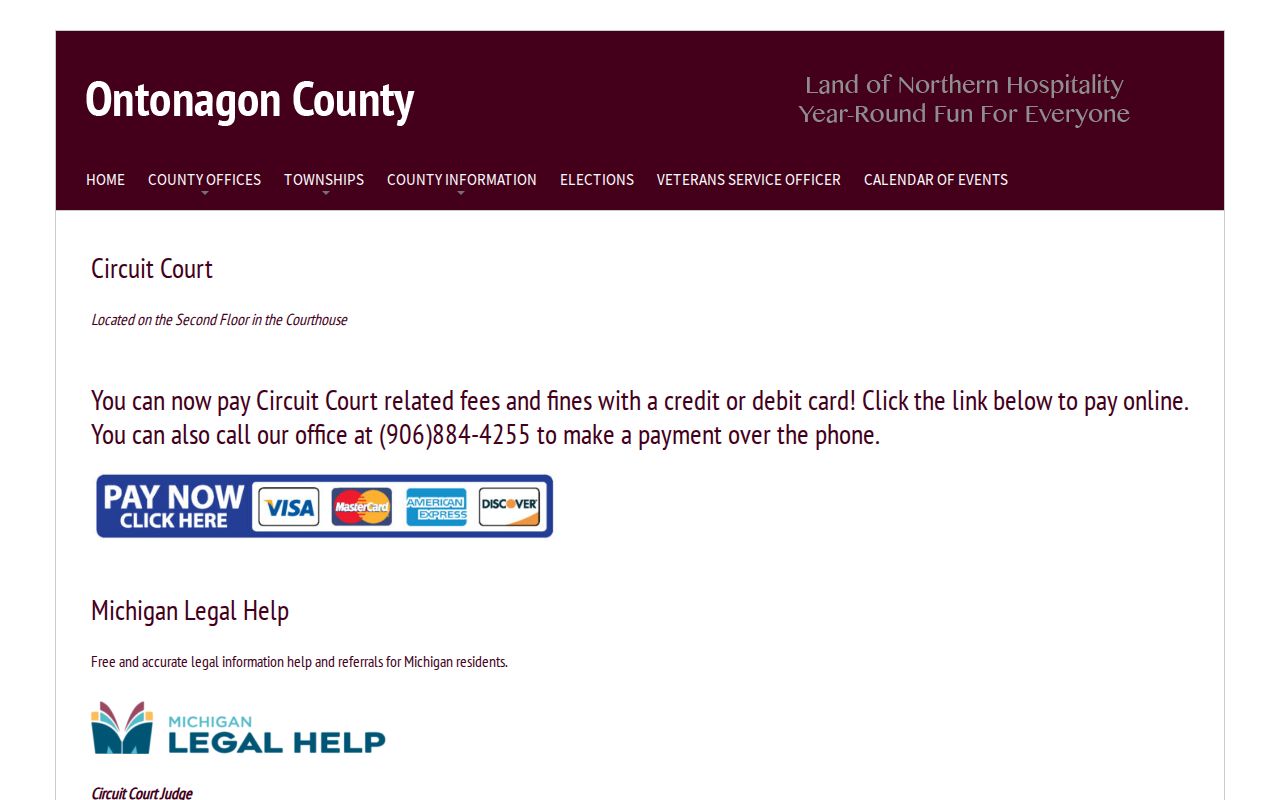
The circuit court page shows the second-floor court office. Its clerk contact handles the felony file, which is where a bound-over Ontonagon County arrest warrant ends up.
Arrest Warrant vs Summons vs Bench Warrant
Three documents can pull a person into an Ontonagon County courtroom. Each one calls for a different response.
| Feature | Arrest Warrant | Summons | Bench Warrant |
|---|---|---|---|
| What it orders | An arrest by an officer | An appearance on your own | An arrest for a missed obligation |
| Basis | Probable cause of an offense | A charge that does not need custody | A failure to appear or comply |
| Who issues it | A judge or magistrate | The court or a charging officer | The judge holding the case |
| How to respond | Surrender, bond, or counsel | Show up on the date | Appear or ask for a recall |
Ignore a summons and it can become a bench warrant. A bench warrant carries the same arrest authority as an arrest warrant, so the stakes do not drop. Ontonagon County readers can trace the failure-to-appear route in more detail on the companion page about bench warrants.
Federal Warrants vs Ontonagon County Warrants
Federal cases never move through the Ontonagon County courthouse. The county sits in the Western District of Michigan, and Upper Peninsula federal matters are heard in Marquette. Federal arrest warrants come from federal judicial process. The U.S. Marshals Service serves them, working with partner agencies. A federal docket will not show up on MiCOURT. The county clerk cannot confirm a federal warrant either, so that office is the wrong place to ask. Federal case information lives in the federal courts' own system, which charges per page and keeps sealed filings sealed. The marshals post no public warrant roster, and no Ontonagon County office holds one for them.
What to Do If There Is a Warrant for You
Talk to a lawyer first. Then contact the issuing court. A lawyer can confirm whether an Ontonagon County warrant is active, explain the charge, and ask about a voluntary appearance under Michigan Court Rule 6.105. That rule lets a person present themselves within a year of issuance. The court must then arraign them or recall the warrant and set a new date. Bond and release conditions usually get sorted out at that first appearance. Skip the drive if a separate license action makes it unlawful. A phone call settles nothing. The county warrant overview walks through the steps in order, from confirming an Ontonagon County warrant to keeping the paperwork that proves it was cleared.
Important: Talk to a lawyer before turning yourself in. An active arrest warrant can lead to a stop at any hour, and counsel can arrange the surrender on your terms.
Sealed and Search Affidavit Limits
Some arrest paperwork stays closed even after the case goes public. A sealed indictment or sealed warrant will not appear in a public case search until a judge opens access. Michigan Court Rule 8.119 governs what may be released and requires protected identifiers to be redacted. Search warrants are a different instrument altogether. They authorize a search of a place or thing, not an arrest. The supporting affidavit is generally not public, so a closed search file tells you nothing about an arrest warrant in the same investigation. Juvenile records in Ontonagon County follow their own access rules. Those limits are separate from the question of a warrant itself.